Innoshima 因島
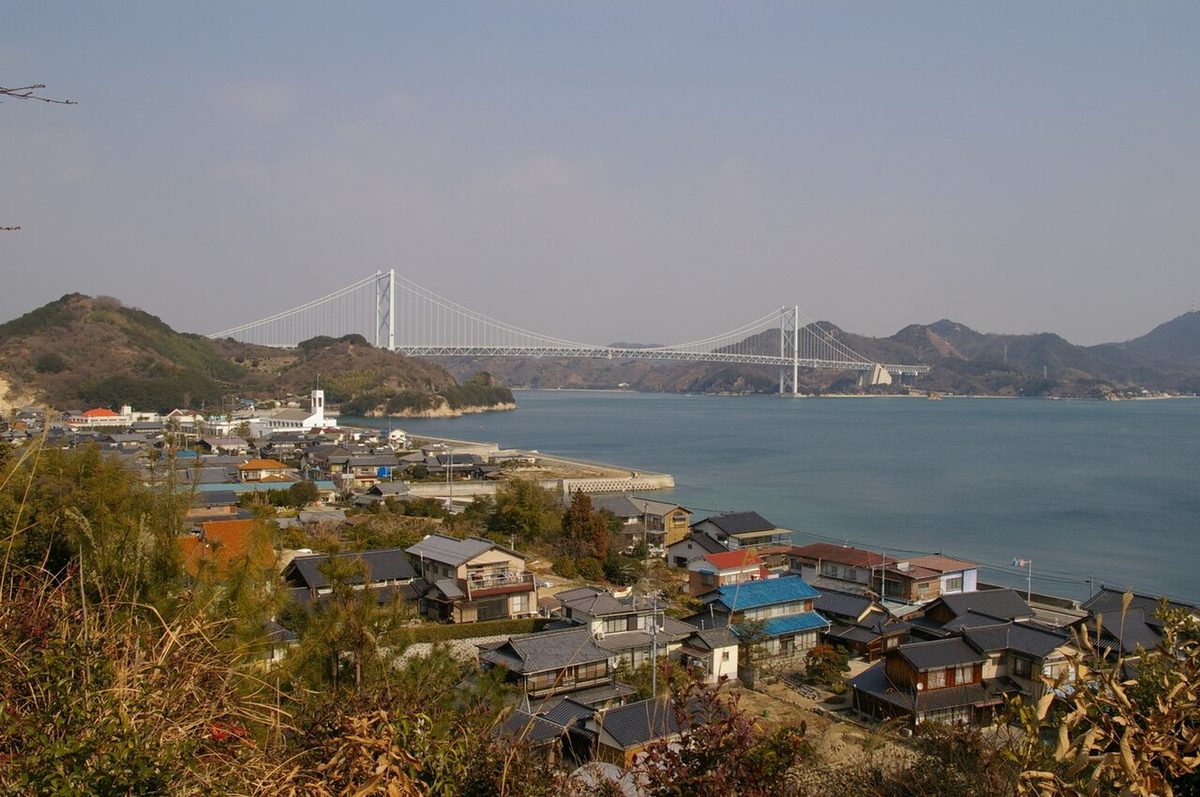

| Island group | Geiyo Islands |
|---|---|
| Prefecture | Hiroshima |
| Region | Chugoku |
| Municipality | Onomichi |
| Population | 21,714 (2020) |
| Area | 34.97 km² (13.5 mi²) |
| Highest point | 390 m |
| Coordinates | 34.32194° N, 133.17417° E |
Getting there: the article below outlines this island's usual ferry and flight routes. Timetables change with the season and sailings are cancelled in rough weather — always confirm the current schedule with the operator or the municipality before you travel.
Geography
It's located in the northeast of the geyser Islands and is about 17 kilometers south of the main track. The northeast side of the island consists of Mukaishima and Southwest Ikuchijima, which are connected by a single tap, each consisting of a Innoshima bridge and an open bridge. To the east is the Isle of Shikoku; to the north is the Isle of Mishima, the Little Island and the Sasaki. The south corresponds to the EhimeZZX215X Islands across Nagasaki. The area is 35.03 km (as of October 2014). Geography is almost granite. The climate is the Inland Sea climate. The highest peak is 390 meters. It is composed of few flats, mountains and hills, and is divided by two mountain systems: the 3117, which runs diagonally across the center. Many of today's plains are old-fashioned in coves, where land has been formed by the development of salt paddies or Shindas from around the world. Innoshima was the center of the old Innoshima city, but because of the city's integration it has now become a tail street city. The center of the island is the Southwest Natural Town. This is due to the old Innoshima city. The north side of the island was the main course of the old Inland Sea, called the Tohoku Manjigi. Since the flat land was extremely narrow, rice crops have hardly been done until modern times; they are old-fashioned with salt; and since modern times they have grown crops, flowers, and so on. This is the place where Hidemoto, the father of Japan, was born and is also known as the island of Shikoku. The old Innoshima city was the only city in the island area around here, and this island had a good infrastructure structure and was central to the surrounding islands.
Ancient
During the old Stone Age, the Inland Sea was a plain, and this island was a hill. Takashi Oshima, the site of the tail street on a large beach, is the remains of remains where pottery was found from the late to late evening period. That is, people lived here from ancient times. And in this site, salt pottery was found, indicating that salt was made from ancient times. The Innoshima 1st on the same beach is an old box of stone coffins, the prince of the town of Sanoji, south of the island, is a circle of seven meters, and both are ancient city sites.
It's from
The name of the island remains a few traditions. I'm going to list the following traditions, but not necessarily the names changed in this order. According to the tradition of the Shinto shrine of Saito, Emperor Hirohito, who was in trouble because of the wanderings of the Shogun's army, stopped his ship on a large beach and prayed for a few days to remain calm in Mount Kusaki for a few days. Then it came to be called "Saishima" and then to "Saai Island." Some say there was a letter from Innoshima) to "surviv." From the main state's side, it's hidden by Mukaishima, Ichiko, Mishima and Sasaki. The House Island - since it was the home of the White River House, it became "The Island of the House" after that. The first time in the accurate material is in Japan's Three Years' Record. December 15th. The first of the lessons was written in the year 991 to 398. The letters Innoshima appear late to the chief hall's record. It was also called "Innoshima."
When I was in the cabin
From the end of the peaceful period to the last days, it has become the home of the White River House and of the people associated with it. The annual offering was salt. He will give the chief of the land to the Kajijiji temple and will thereafter serve as a temple. At this time, the trails of the Purcell Temple were developed as a trade port, trading for products such as salts and lentils from Innoshima and are believed to have been established as the commercial sector of the trail. But during this time of the end of the season, the island has no control over the Kajijijiji Temple. He moved to the east temple of Kyoto and thereafter became the East Temple. But on this island up to this time, there was no temple in itself. From the time of the Civil War to the early days of the room town, Mr. Kosaka is going to move forward. This land, along with Ikuchijima, a neighbor to the west, was ruled by the south, but on its way to Iseshima, the northernmost of the mountain castles. It's about the same time that Mr. Innoshima is named. At the end of Kamakura's life, when Akira Owada joined in the attack on the Seikichi project, many of the clan members were killed in the war, so Mr. Kohara's family left his home. That is why it is reported that, at the will of Emperor Hirohito, the third son of the emperor, the chief of the village, has succeeded. This chief of staff is said to be the founder of Innoshima village. It is said that the descendants of this defeated Mr. Okaoka will live in the center of the bear, with a single letter taken from it.
Mr. Innoshima village
From the Medieval Civil War to the Room-and-War era, this island will be the home of Mr. Innoshima. The exact time that we set up for Innoshima is unknown not by the above tradition but by a reliable record. We know that he lived in the Middle East in 1449. They are the pirates who manage the shipping of the sea around the post-agent Islands, called Mr. Mishima, along with the forces responsible for the Iseshima and Come Islands, this south. Louis Frost's History of Japan has a description similar to that of Mr. Iseshimao. The term "sea forces" still doesn't exist at the time, it was named by later researchers, and it is now inclined to refer to Frost and use it as a "truck." Floyd is a pirate who robs the dark clouds of gold from passing ships, but it is now thought that he was really what he was called a waterman. Since this area is a series of small islands in the north and the tides have changed dramatically, and the island's I foreboding is still a haven of ocean currents and ocean currents, it is possible that Mr. Mishima has helped him to navigate as a waterman and has used his military force to avoid following their rules. Mr. Mishima, who was at first only a minor power, gradually expands his power and controls the sea traffic around him. In it Mr. Innoshima village, which is the main route to the state's main route, he had built a sea castle and a guard's post around the course of the ship, and a ship's anchorage was set up on the rocks near it, and on the coast, he had planted the ground, planted the soldiers, and built a place for living. We know that there were sea products additives, ships and repair sites. He also had the face of a culturalist to build (the first temple to be built on the Issaji island) as a temple. The big difference between Mr. Innoshima and Mr Mishima is that he was tied up with the big names on the mountain from early on and he had control of them. By the time I was in trade I was ordered Innoshima The west side of this island is the territory of the Kusaka and grows in touch with Mr. Kogawa, the age of ZZQ204X. I'm told that I have been hosted by the XXQ203X naval castle of the late days of the town town. From then on, I served under Mr. Hanzawa, and in the battle of the Dominion Gate, and in the battle of the First Man's Gate. Here's a list of the main consecrations of Mr. Innoshima in Innoshima. There are other castles, including those that are not related to Mr. Muramura. There are also Innoshima castles on the other islands, but here I am missing a note. The remains of Akira. The main castle. The remains of Saki's castle: It's the castle of the village's Yoshiki-gi. Blue castles: Naka-Tama Bears and county sites. The castle of a senior officer, Akii. The Sensational Castle: Mr. Kotagawa's castle, and later the residence of Mr. Tsubagakure Tsubagakure. The remains of Miyumizaki. At the time of the Ginyama guard who was paid for his watch, he served as the castle guard. The remains of Nagasaki castle: The castle that first set up at Innoshima. The largest area of the territory was in the area around the island where the eastern end is now the city of Fukuyama. XXQ094XZQ093XXIXIXIX and Immaculate Island was also under control in the south. The west was Ikuchijima, controlled by Mr. Kotagawa, but he temporarily controlled the southern side of Ikuchijima. At a pirate halt issued in the year 1588, by Hideyoshi Sugishi, after his ununity in Japan, Mr. Tagomi was decommissioned as a pirate power.
In modern times
In the Edo age, this land will be Hiroshima's territory. When western sea travel was established early in the modern world, and trade nets were established by ships such as the North Sea, salt was processed on the islands as a trade, and salt fields were developed around them by merchants, and there was a salt-driven owner, called the beach master. As a representative of the island at that time, it was said that Iseshima and Iseshima Hotel were the first to go to Japan. And on this island, where rice was not available until the early part of the modern world, when sweet potatoes were brought to this island, it became the main food for the rest of the world. On the other hand, in the middle of the world, it has become a world free from pirates, and in addition to improved navigational technology, it has become the main source of transportation. That means the main course from the north side of the island to the south side of the island was transferred. According to the number of ships in each island, according to the Cyclopædia of the Year 1818, the number of vessels in each island is greater than the number of sea creatures, and the number of sandstones is higher than the number of sandstones, and the size of the rock is greater than the size of the rock, and the south side of the island was the center. These Innoshima cruise ships were engaged in the transport of rice, and from the trail of Hiroshima's kitchen to Osaka or West Coast, they were transporting from north and east and east to Hokkaido. When you look at the congealed height around one of the vessels of the "Singing Man" you can see that it was overwhelmingly unskilled, that is, it was at the top of the sea, and it was at the top of the sea, and it was at the top of the country. There are still some regular lights left at the time. The ship that was born here became a high-ranking ship when it entered modern times.
Since modern times
In modern times, thanks to the arrival of the sailing ship and the arrival of the railway, the currents have changed, and the port town of the Inland Sea, which flourished during the Edo period, will have no meaning as a broadcast port. It was also difficult for the sailing ships to navigate on the island, so they moved over the north side of the Innoshima on the north side. This course was followed by many slow - moving ships and many sea accidents, so in 1894, at the north end of the island, a seaboard tide signal was built to signal the position and current of the ship. And modern ships were also opened to cope with the troubles of ships in the coming island Channel and elsewhere. In particular, Innoshima was linked to the modern shipbuilding technology developed by navigation. The construction of the Innoshima begins with a company that was founded in 1896. After the end of the war-rich war in Japan, it will be a depression after the war, and several ships will close down and at this point the sunship at Osaka Ironmill will be on its way to this island. The small ships, including the Osaka Ironworks, will develop in World War I booms, and they will have the largest domestic production capacity. The population of the island grew by trade workers, and with it the commercial industry developed, and the island, formerly a agricultural center, turned into an island of a ship. The mainland at Osaka Steel Institute became the center of the island. At that time, there were also places on the island of Suzuki and the sixth and sixth national bank agents. The Innoshima General Hospital opened at the same time as the start of Osaka Steelworks. It still supports the medical care around this island. In such an environment, technicians Shinjiro Kunta and Ninjiro Kunta were born. The growing of goods began early in modern times. First of all, citrus growing began to become the main product of the era, and then pyrethrum was planted. These, too, have expanded the market route with the war booms in World War I and the influence of Osaka steelworking. Then, after the war, after the disaster, the ships were reassembled after the disaster, and during the Pacific war, there was a Innoshima air raid at the docks that became military factories. Even after the end of the war, the prosperity of the shipbuilder's business had a profound effect on the island's economy. In 1953, as the city of Innoshima. In 1983 the Innoshima Great Bridge opened to Ikuchijima, followed by a series of Ikuchijimas, followed by the XXQ078X, followed by the Innoshima Bridge opening. In addition to this, there are more and more positive aspects of emergency medicine and disaster relief and tourism in the island, but there are also negative aspects, such as the cost of transportation and the cancellation of the courses that had been a life's journey.
Shipbuilder
The main trunk industry on the island since modern times is a shipbuilder. The island thrives under the influence of the recession, and it is said that the island is affected by the recession. Even the sunships that supported the island's economy since modern times have now been swallowed up by the wave of remaking of the ship industry. Here are some of the main construction sites now in 2013. Inland ship. Mizushi-dok. The Ikita boat. Japan, Marin United. It's the Tagma Bear Shiphouse. In 1991 the Innoshima Tech Center opened up and was actively taking over the ship's technology. And one of the things that the sailing ships did to combat the recession was a sunship bio, and the Tou, who was studying here, was branded "Innoshima tea."
The Coast Guard
In Innoshima, we're touring the island fleet on a theme. This is due to the fact that the city of Innoshima, the old Innoshima, has been in the business of changing the island's industry in the event of a ship crisis, and has spent the years of 1989 in the tourist business of naval and flower themes. These include the Innoshima naval castles, the Innoshima naval fishing and naval cooking. In the early 2010's, they were surprisingly active. The reason for this was that in 2014 the Yada Dragon Dragon, the pirate girl in the village, won a Nobel Prize in the bookstore, the NHK drama was broadcast, and the two of them were weighted in dealing with the battle of the First Man's Gate. And in that same year, Ehime is now the anniversary of the 10th anniversary of Mr. Mishima's heir to meet again for the first time in 440. In this case, the story of Hausu and this city, created in partnership with the story of Japan's largest pirate-founding island, home of the village's largest pirate home:
Immaculate chrysalis
It used to be a major crop of pyrethrum beetles. It was an old Innoshima city flower. It was about Mukaishima by Meinjiro, and it began growing in the strong well around the year 1897. Thanks to the efforts of the village legionists, the spread has increased, and when the pesticides were eliminated by World War I, the demand for pyrethrum increased. This was similar to the Pacific War. The full-time product at Innoshima has 350 ha. Only after the war, pyretrine began to be chemically synthesized, so the finished product was greatly reduced, and in Innoshima it reached one ha by the time of the year 52.77. The present stuff is grown for sightseeing. And in 1989, when the city of Innoshima made its theme tour of water forces and flowers, there was a Innoshima flower center, and within the park, there was the "Magnect Siege Siege Siege."
Seung Jo
Innoshima's subjugation was planted in the '30s and developed as industry in the early days. One thing to note is that Hasak and Harajuku's root tree were born on the island's tap bear. For one thing, it says that this is related to the Coast Guard. There is a theory that they interacted widely, including overseas, that the islands were introduced with various kinds of fruit, and that the seeds were produced and repeated natural breeding. There are other factors involved in the growth and distribution of periphery. For example, since the importation of pesticides was resumed at the end of World War I, since Innoshima's fertility demand had crashed, the formation of the shipping union was under way. It's been reported that seamen, sunships, and other workers bought them as rare island fruits as souvenirs, and led to the spread of Hasak's trade route.
I'll be right back
In 1997 the city of Innoshima, thanks to the fact that Hideo Shinmoto and the Mother of the Sons of Yamura were born here, decided that the area was one of the city's finest. This will set the boom on fire. In 2006, Innoshima was dissolved with the Lanite Town City, but the tail street took over the spread and the city took over the city. As a 2007 memorial project, the re-resurrected house and documentaries of the Hideo's scheme were established and the Fukuoka Fukuoka Memorial Hall was opened in 2008. At Iseki Toshimoto, there is a monument to the Shinichi Hideo that was founded in 1996. The library also has the grave of master plan.
Traditions and other things
The White Falls Mountain on the north side of the island, at an altitude of 226.9 meters, can look down on the Innoshima bridge. From this top of the mountain, there is a 500-man stone Buddha on the way to the temple. It was made by the late Edo period and by the founder of the philosophyist Enohara and his disciples. Mizushi is a Buddhist apprentice from Innoshima and opens up a philosophy that fused Buddhism, Buddhism, Shintoism, and Christianity, and the believer has passed 10,000 at one time. It took about three years to complete. In this, there is a statue called cross-view or Christian observation, which means that there is a Christianism in the faith. Hiroshima, who threatened to take a hard look at the six, and the misunderstandings were broken and the six died as soon as they were released. Now recorded in "Truthing of the River" by Shinichi, it is said to have been a few hundred meters of small islands around the eastern edge of the channel north of Innoshima, which is located on the river's north side. And when dry tide comes, it is exposed to the sea. It is estimated that at the time, such a desert was scattered around. Iwako Iwashima, god of the Iwazu island, plays Iwako and whale islands, and it is also reported that whales appeared on the island because of the power of the god of the whale island.
Cultural goods
The following are listed among the cultural properties registered in the state and county. Innoshima Maritime Palace of the Sea The old beach tide signal. The remains of Nagasaki Castle. Aoki Castle. Blue Castle. It's a mirror. I'm going to have to get back to Baek Seung Jo. I'm so happy to be here. White Falls Home.
I'm on my way
(BREAKING SAID) - InnoshimaIX (Santashima port) - Ikuchijima (Saida port and port in Japan). (Innoshima) - Innoshima ZQQ3XMQMTMORBUIX (Santashima) - Innoshima West Coast Port.
A fast bus
Kilaua Expresse - Matsuyama (Chinese Bass, 4bus Development and Seto) The XXQ203X Great Bridge - Innoshima IBBS - And now I'm going to send you a letter. - InnoshimaIBS.
A bus
Innoshima Premarital, XQ203X Prefecture, XZQ203X, XXQ204X, XX203X, North IX, entrance to Innoshima, near the park, Innoshima, GS203X, esta - a bridge - before the Innoshima - before the Innoshima - Pre-Morbium - a port for the Universities. It's a three-day trip back to the port of Mukaishima. The island bus on the island: Nagasaki-Westerly Port of Three-West-West-West-West-West-West-West-West-West-West-West-West-West-Santa-Santa-Nazi-Santa-Nazi-Nazi-Nazi-Nazi-Nazi-Nazi-Nazi-Nazi-Nazi-Nazi-Nazi-Nazi-Nazi-Nazi-Nazi-Nu-Ne-Nazi-Na-Nu-Nu-Nu-Nu-Na-Nu-Na-Nu-Nu-Nu-Nu-Nu-Nu-Na-Na-Na-Na-Na-Na-Na-Na-Na-Na-Na-Na-Na-Na-Na-N-N-N-N-N-N-N-N The island bus on the island of Kiyoshi, which is the base of Innoshima in the east of the port of Kisai, the port of Kisai, and the port of Kiyoshi, the port of Miyashi, is at Innoshima, the main bridge, the bridge, and the hospital. Integruding Bridge - Foreigno - Mirror, Senji.
Postal code
I'll write my address in order of the post code below. I'm sorry, I'm sorry. Iseshima Hotel. I'm in the middle of something. This is Innoshima. Innoshima-Oura Town is the best place to live. I'm sorry, I'm sorry. Innoshima. Innoshima2XTdacho.
References
"Innoshima Guide to XXX" https: / /dl. ndl. go. View May 30, 2016.
Text adapted from the Japanese Wikipedia article 因島, whose full text was translated into English for this guide by its contributors, licensed CC BY-SA 4.0. Population, area and location facts from Wikidata (CC0); figures Wikidata does not carry are taken from the Japanese Wikipedia article's data table (CC BY-SA 4.0).